Day 1: Arrival in Ulaanbaatar, Airport Pick-up
Welcome to our 9-day tour in Mongolia! Upon your arrival at Ulaanbaatar airport, your private guide and the driver will greet you and escort you to the downtown hotel. Then you can relax to recover from jet lag or go for a walk nearby on your own. Interestingly, in such a nomadic country, you might find a lot of Korean-style eateries, convenience stores, and beauty parlors in the city center, especially on Seoul Street, because young people in Mongolia today are very fascinated by Korean culture. People even say that "Genghis Khan conquered the world, and Korean culture has conquered Mongolia."
► Why choose us?
1. Transportation: Mongolia’s natural essence lies in its Gobi Desert and vast steppes, which are isolated locations without proper roads, and navigating them relies on the expertise of locals. Your private vehicles and the local driver will not only save you from these hassles but also allow you to stop at any time and truly experience the local life.
2. Language: The majority of pastoral herders do not speak English, and some scenic spots and museums lack English explanations. Your knowledgeable English-speaking guides will provide explanations and ensure effective communication with locals.
Accommodation: Grand Hill Hotel Ulaanbaatar (4 stars) or similar
|
Day 2: Ulaanbaatar - Genghis Khan Statue Complex - Chinggis City
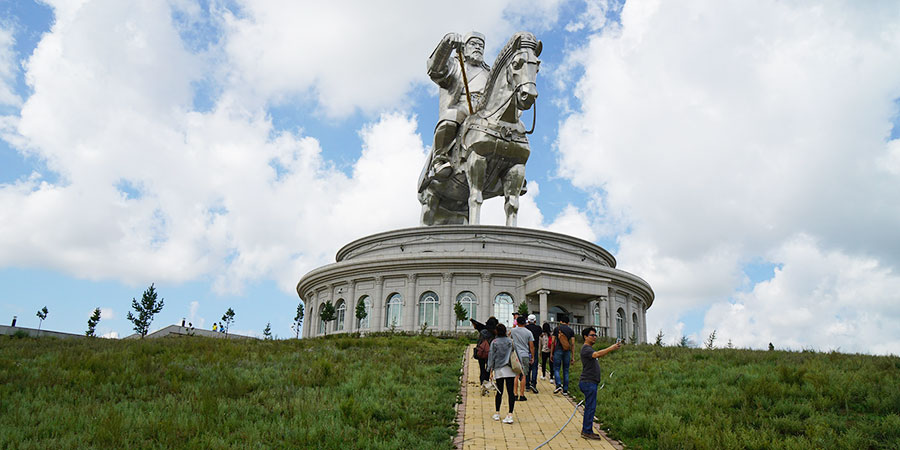
After breakfast, your guide and the driver will accompany you on a 6-hour drive to Chinggis City. Originally called Ondorkhaan, the city was renamed in 2013 to honor Genghis Khan, the founder of the great Mongol Empire (1206-1368 AD). En route, stop by the Genghis Khan Statue Complex to admire the 40-meter (131-foot) tall statue of Genghis Khan on horseback, made of stainless steel, which is the world’s largest equestrian statue. In its museum at the statue base, catch a glimpse of the valuable artifacts from the Huns period (4th-6th century) to the Mongol Empire, including traditional attire and weaponry. Then, ascend to the viewing platform above the horse’s head for a broad view of the boundless grassland. There is a spot offering photo-taking with an eagle for around MNT 20,000 (USD 5.5) outside the complex. You can have a try on your own if you like. ► Genghis Khan: Legendary Conqueror of the Mongolian Steppe Genghis Khan stands alongside Napoleon, Julius Caesar, and Peter the Great as one of the world’s most transformative figures. Although born the eldest son of a powerful chieftain of the Kiyad Clan, he endured great hardships in his youth. However, he forged his own cavalry through unwavering will and led his troops with exceptional wisdom. For example, he ingeniously utilized the nomadic tradition of moving with livestock, bringing vast herds of cattle and sheep along with his army during conquests. These herds served as mobile larders, providing fresh meat and dairy for his soldiers. Continue our drive to Chinggis City. After checking into the hotel, follow your guide on a brief city tour. We’ll visit the Chinggis Khaan Central Square, where the Genghis Khan statue faces southwest, the direction in which he expanded his realm! Take a leisurely stroll along the winding Kherlen River, where locals usually gather for fishing. If time permits, explore a small local market that offers homemade dairy items, brick tea, and dried meat. At last, your guide will escort you back to your hotel. Meals: Breakfast, Lunch, Dinner Accommodation: Ezent Guren Hotel or similar
|
Day 3: Chinggis City - Dadal Village (Birthplace of Genghis Khan)
★ Unveil the Mystery of Genghis Khan's BirthplaceAfter breakfast, your guide and the driver will accompany you on a 6.5-hour drive to Dadal Village, which is widely believed to be the great man’s birthplace. His exact birthplace remains mysterious, but given the Mongols’ nomadic nature, the ambiguity is hardly surprising. The historical masterpiece "Secret History of the Mongols" records only that he was born in Deluun Boldog in the Khentii Mountains - a description that fits both Dadal and Binder villages. The thick forests and isolated mountain ranges sheltered him from tribal conflicts in his youth. In gratitude, he prayed to them every day, and the reverence still prevails among Mongolians nowadays. Wandering through Dadal, savor the incredible scenery of the mountains cloaked in sturdy, lush pine and birch forests, and Russian-style wooden houses with vibrant roofs. Today, this area is home mainly to the Buryat people, an ancient Mongolian branch. At last, your guide and the driver will escort you to the local camp.
Meals: Breakfast, Lunch, Dinner
Accommodation: Chingis 3 Lake Tourist Camp or similar
|
Day 4: Dadal Village - Deluun Boldog - Khajuu Springs - Binder Village
After breakfast, let’s head to Deluun Boldog, a historic site situated near the border, a few kilometers northeast of Dadal Village. With the Onon and Balj Rivers meandering through, this secluded rural attraction is home to lush meadows, rounded hills, shallow valleys, and a plethora of wild animals. Deluun Boldog, meaning "a hill shaped like a spleen," got its name as a tale said that when Genghis Khan was born in 1162, his father, Yesugei, slaughtered a horse to celebrate and buried its spleen here. In addition, there is a huge ovoo, a sacred stone mound for worship, and you can follow the local tradition by adding a stone and walking around it clockwise three times for blessings. Then, visit the nearby Khajuu Springs successively, said to be Genghis Khan’s first purification ritual site, and a local Mongolian hunter's ger museum that displays hunting gear and specimens of wildlife he hunted, such as wolves and leopards.
In the afternoon, we’ll explore Binder Village, another disputed site related to Genghis Khan’s birthplace, whose surrounding open fields stretch wide, with lush grass, clear streams, and cattle and sheep freely grazing. Finally, your guide and the driver will escort you to the ger camp in the nearby Kurkh River Valley.
Meals: Breakfast, Lunch, Dinner
Accommodation: Chingis Toonot Tourist Camp or similar
|
Day 5: Visit Rashaan Had Rock, Deer Monuments, Binder Ovoo, Ancestor's Wall, Baldan Bereeven Monastery
After breakfast, your guide and the driver will accompany you to discover Rashaan Had Rock, which boasts numerous rock carvings of animals and inscriptions from the Paleolithic through the Bronze and Iron Ages (around 3.3 million BCE-500 BCE). Then, proceed to the Deer Monuments to see the enigmatic standing stones with reindeer engravings scattered across the wide-open steppe. Early stones have simple deer carvings, and later ones feature more elaborate flying deer, with some pieces even including sun patterns on the deer antlers. We’ll also stop by Binder Ovoo, a sacred shamanism site used for worshipping local spirits, usually draped with strips of blue khadag. Our last stop this morning is Ancestor's Wall, aka Uglugchin Kherem. The 13th-century red granite wall stands 3 meters (9 feet) high and stretches for 8 kilometers (5 miles), and its purpose remains a mystery.
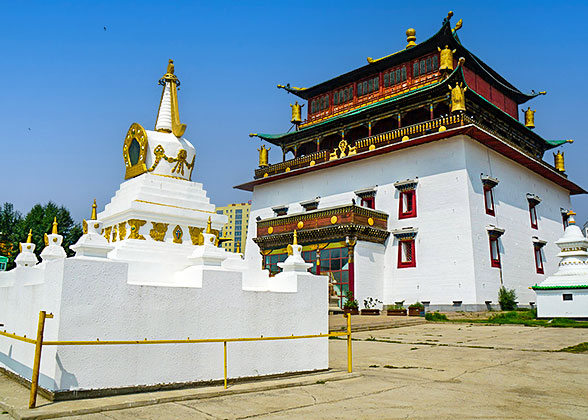
Let’s tick off Baldan Bereeven Monastery on our list in the afternoon. As the local center of Gelugpa Buddhism, it once housed thousands of monks in the mid-17th century. Despite being destroyed during the purges, the three restored temples, numerous stupas, and the remnants of the demolished temples that still survive atop the ruins all convey its past glory. Admire its striking Tibetan-style architecture, characterized by white walls, red pillars, and green and dark-red roofs.
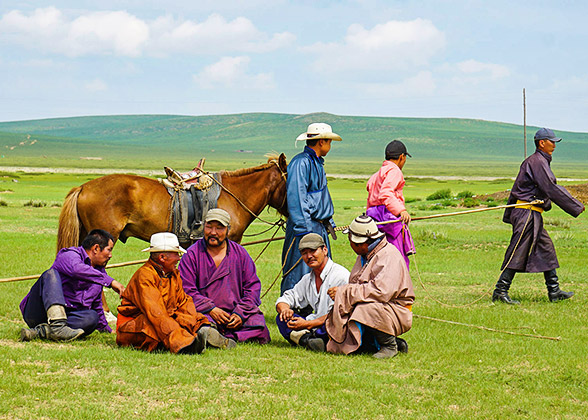
★ Experience Authentic Nomadic Life & Overnight at a Local Family!Afterward, follow your guide to visit a native nomadic family! A Mongolian herding family generally consists of two or three gers, a spouse, three or five dogs, five or six children, and dozens or even hundreds of cattle, sheep, and horses. Every day, the mother and her little daughter milk the livestock, and the father and young boys herd sheep and calves on horseback. Roll up your sleeves and live like a nomad! Assist the hosts in feeding the livestock, make Mongolian dumplings, and witness how they light the stove with firewood to cook and keep warm. Tonight, rest at the host’s ger camp. Drift off to sleep while wondering whether life here remains the same as it was thousands of years ago. Perhaps you’ll find the answer the next morning when you awaken to the lambs bleating and bask in the first rays of sunlight.
Meals: Breakfast, Box-Lunch, Dinner
Accommodation: Nomad family’s Ger or similar
|
Day 6: Blue Lake (Khökh Nuur) - Gun Galuut Natural Reserve
Today, we’ll explore the beautiful Blue Lake. This small lake, surrounded by lush forests, is home to a wide variety of flora and fauna, and has left a significant mark on Mongolian history: in 1189, Genghis Khan was honored as the Khan of the Kiyad Clan here. There is also a monument dedicated to him on the lakeshore, surrounded by 36 wooden sculptures of his royal family, creating a magnificent tableau.
► Genghis Khan's Difficult Youth
Although Genghis Khan was born into a noble family, he never really got to enjoy the good life. When he was nine, his father was poisoned by a rival tribe on the way back from arranging his marriage. He was then forced to begin a life on the run. Fearing retaliation, the rival tribe caught him and shackled him for public display. Fortunately, he successfully escaped. However, a few years later, his wife was abducted shortly after their wedding. The successive blows made Genghis Khan realize that he must build his own army to survive in the predatory grassland. He then began to build alliances to his side and was proclaimed Khan at only 27!
After lunch, we’ll drive 3 hours to Gun Galuut Natural Reserve, an ecosystem consisting of mountains, grasslands, and lakes, nurturing many endangered wildlife. And the Tsengiin Burd Wetland and the Kherlen River are breeding grounds for a variety of bird species. You can also enjoy a horseback ride on the open steppe at your own expense if you wish. Before dusk, your guide and the driver will escort you to today’s ger camp.
Meals: Breakfast, Lunch, Dinner
Accommodation: Steppe Nomads Tourist Camp or similar
|
Day 7: Terelj National Park: Turtle Rock and Ariyabal Meditation Temple; Visit a Nomadic Family
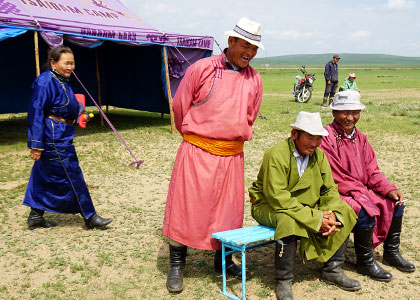
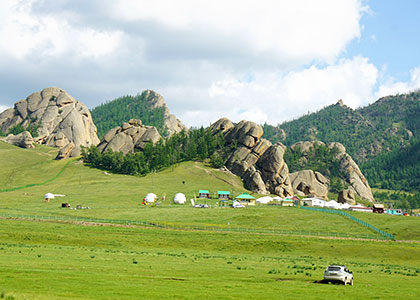
Today, let’s answer the call of Terelj National Park. Located on the southeastern slope of the Khentei Mountains, it boasts breathtaking landscapes, encompassing verdant grasslands, lush woods, peculiar boulders, and wild animals such as marmots and ground squirrels. As soon as we reach the park, you’ll behold the giant Turtle Rock from afar, a 24-meter (75-foot) high icon. It is also regarded by the locals as a symbol of wealth since a tribal army once concealed their gold, silver, and gems here. Afterward, visit the serene Ariyabal Meditation Temple on the hillside, surrounded by pine forests and offering a panoramic view of the whole park. To reach the temple, we need to climb 108 steps, which symbolize 108 kinds of troubles that need to be resolved through spiritual practice in Buddhism. Besides, you can enjoy a horse trek in the vast park on your own if you like. In addition to natural marvels, you can also visit a nomadic family. The hospitable hosts will treat you to fragrant Suutei tsai milk tea, or slightly sour, bubbly fermented mare's milk, the most authentic tastes of nomadic life. You can also learn to milk a mare: let the foal suckle first before taking over. Just watch out, or you might end up with mare's milk splashing onto your face! After the visit, your guide and the driver will escort you to your ger camp. Meals: Breakfast, Lunch, Dinner Accommodation: Terelj Lodge Ger Camp or similar Local nomadic people Terelj National Park
|
Day 8: Ulaanbaatar: Zaisan Memorial Hill, Sukhbaatar Square, Mongolian Music & Dance Show
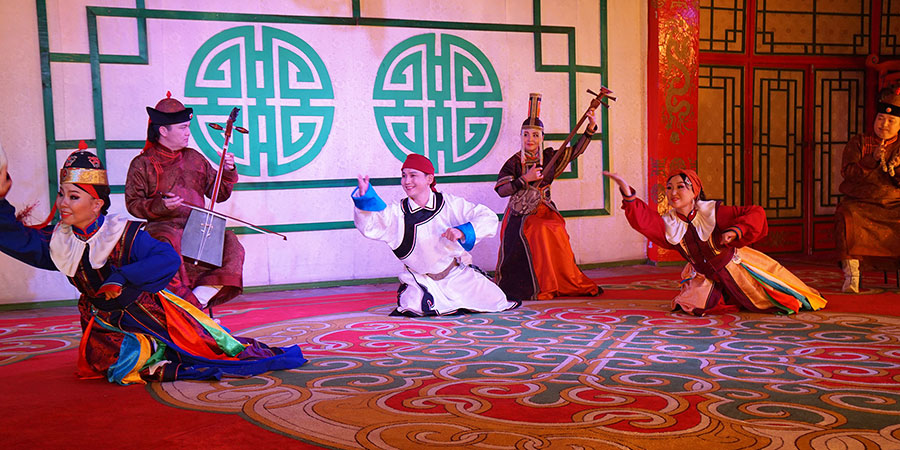
After breakfast, we’ll take a 2-hour drive back to Ulaanbaatar. Upon arrival, your guide will accompany you to Zaisan Memorial Hill. The massive circular mural monument was built as a tribute to the Mongolian and Soviet soldiers who lost their lives during World War II (1939-1945 AD). Reach the summit by the elevator in the monument mall and enjoy the view of the surrounding mountains and the city, which blends modern buildings in the city center with ger slums on the suburban slopes. It's windy here, so bring a coat and a hat. After lunch, let’s stroll around Sukhbaatar Square in the city center, which is named for the revolutionary leader Sukhbaatar. It is bordered by the city's most significant structures, including the Parliament, Cultural Palace, and National Opera House. Then, we’ll leave you some free time to explore the city at your own pace. Maybe visit the Naratuul Open Air Market, the largest market in Ulaanbaatar, teeming with everything from Mongolian robes and woolen socks to horse gear and even shamanic instruments at the corner shops. ★ Farewell Dinner with Fantastic Mongolian Dance ShowAt the scheduled time, your guide will accompany you to a farewell dinner along with amazing music and dance shows, including nomads' proud throat singing and the old, enigmatic shaman dance. Prepare to be wowed by the dancers’ elaborate costumes and masks, which were inspired by sacrificial rites! At last, your guide will escort you back to your hotel. Meals: Breakfast, Lunch, Dinner Accommodation: Grand Hill Hotel Ulaanbaatar (4 stars) or similar
|
Day 9: Ulaanbaatar Departure, Airport See-off
Today marks the end of your 9 days Mongolia tour with Ulaanbaatar and horse treks. Your guide and the driver will pick you up at your hotel and escort you to the airport. We wish you a smooth journey back!
If you’d like to delve deeper into the country’s nomadic culture, such as taking part in the two-day Golden Eagle Festival to experience the 2,000-year-old eagle hunting tradition, witnessing thrilling falcon hunts and a tug-of-war with a headless goat, please feel free to contact us, and we’ll tailor a hassle-free tour for you!
Meal: Breakfast
|